
For a long time, I was chasing routines that didn’t really fit. I’d watch videos or read articles about perfect morning routines, wake up at 5am, workout, journal, green smoothie, conquer the world by 9. And every time I tried to copy them, I’d burn out within a week.
The truth is, what works for someone else might not work for you.
So I stopped trying to “hack” my days and started listening instead. I didn’t need another rigid schedule. I needed a rhythm, something softer, more human. Something that actually felt like me.
And slowly, I found it.
What Is a Daily Rhythm?
To me, a rhythm is different from a routine.
- A routine feels like a checklist.
- A rhythm feels like a song.
There’s flow. Flexibility. It changes with the seasons, with my mood, with my energy. It’s not about doing the same thing at the same time every day, it’s about moving through the day in a way that supports your body, your heart, and your life.
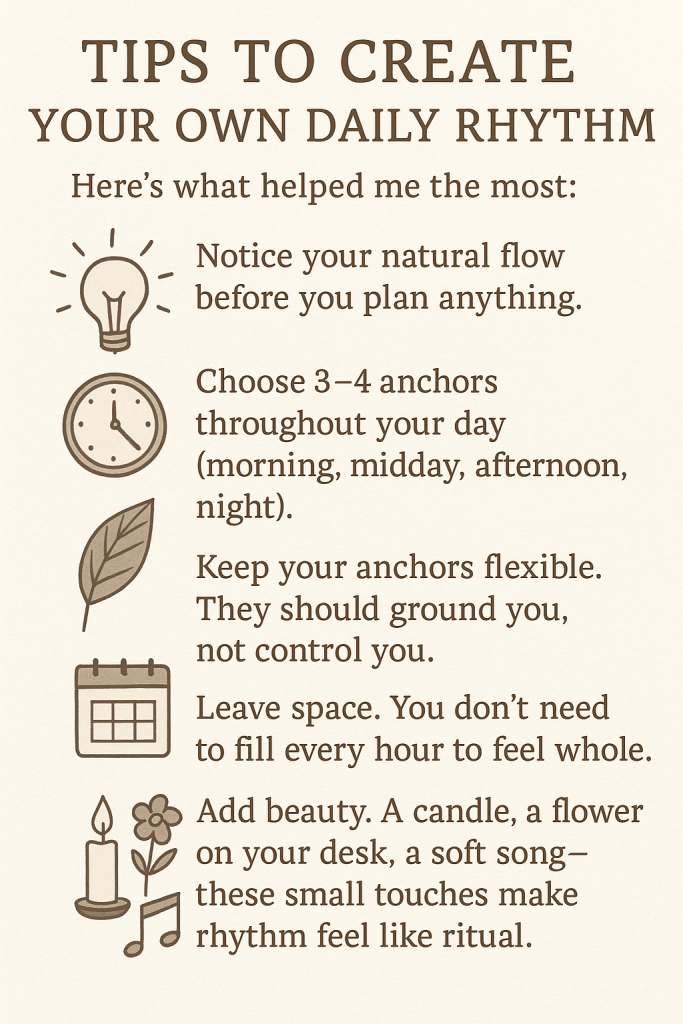
Step One: Observe Before You Fix
I started by simply watching myself.
What time did I naturally wake up? When did I have the most energy? When did I start to feel drained?
I kept a little log for a few days, not to judge, just to notice.
✨ I learned:
- I’m most creative in the late morning.
- I crash hard around 3pm if I skip lunch or don’t take a break.
- If I don’t build in softness in the morning, the rest of the day feels rushed.
That alone told me what I needed: a slower start, a creative pocket mid-morning, and rest built in before I hit a wall.
Step Two: Design Anchors, Not Schedules
Instead of a strict timeline, I created anchors, gentle rituals that guide me from one part of the day to the next.
Here’s what mine look like right now:
🌅 Morning Anchor: Soft start, warm drink, one page read
Before I do anything “productive,” I light a candle or open a window. I make something warm, tea, coffee, or lemon water, and read one page from a book I love. Just one. Just to begin.
🕰️ Midday Anchor: Nourishment & creative work
Around 10:30 or 11, I settle into creative projects, writing, dreaming, designing. I always have something nourishing nearby (even if it’s just buttered toast and fruit). I try to do deep work before checking my phone.
🌤️ Afternoon Anchor: Reset & light task zone
I pause for a true break around 2 or 3. A walk, a stretch, sometimes just sitting outside for a few minutes. After that, I tackle easier tasks, emails, errands, cleaning up.
🌙 Evening Anchor: Wind-down with intention
I put my phone away early (okay, I try). I make tea, journal if I feel like it, or prep something cozy for tomorrow, like laying out clothes or jotting a recipe idea. This anchor is more about closing the day softly than cramming in more.
Step Three: Let It Evolve
I didn’t figure this out in a weekend. I’m still adjusting, especially when life gets chaotic. But the rhythm always gives me a place to return to.
And I remind myself often: It’s okay if things change. So do I.
Some weeks are slower, some are packed. Some mornings I scroll too much or skip breakfast. That’s fine. The rhythm is there to hold me, not shame me.
But What If You Work a 9–5 (or More)?
Let’s talk about this, because not everyone has the freedom to design slow, spacious mornings or take afternoon walks through the garden. I see you.
Maybe you have to be out the door by 7:30, or you’re juggling work and family, or you’re in a season where everything feels like survival. Creating a “daily rhythm” doesn’t mean you have to quit your job or live in a cabin in the woods. (Though hey, no judgment if that’s the dream.)
Here’s what I suggest instead:
Think of rhythm not as something big and ideal, but something small and kind that fits into your real life.
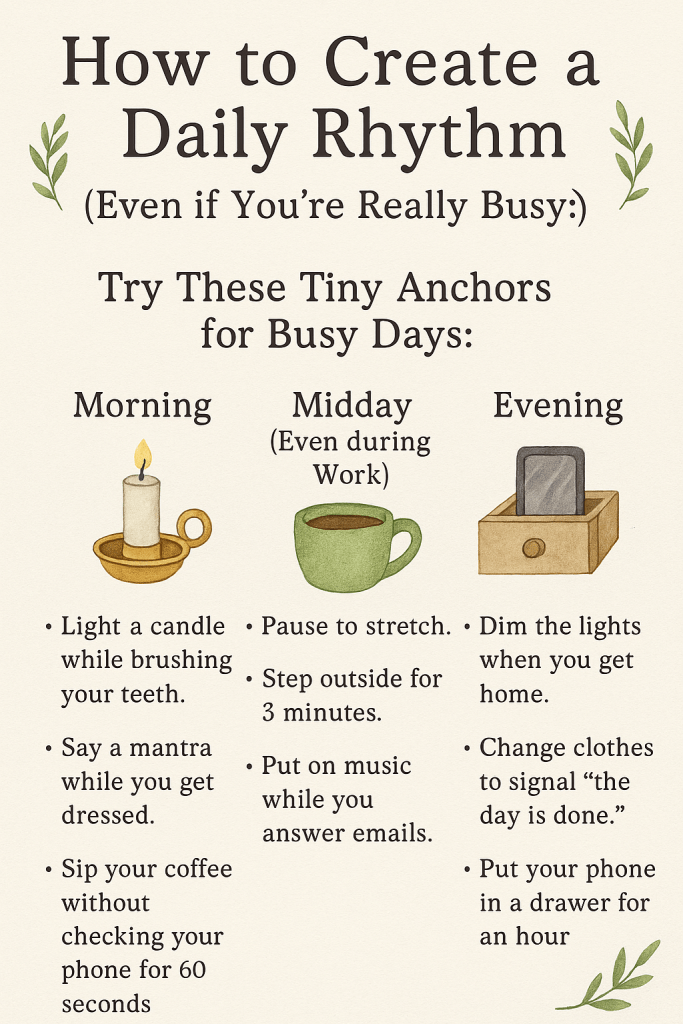
Try These Tiny Anchors for Busy Days:
- Morning: Light a candle while brushing your teeth. Say a mantra while you get dressed. Sip your coffee without checking your phone for 60 seconds.
- Midday (even during work): Pause to stretch. Step outside for 3 minutes. Put on music while you answer emails.
- Evening: Dim the lights when you get home. Change clothes to signal “the day is done.” Put your phone in a drawer for an hour.
These aren’t about doing more, they’re about choosing what matters in the pockets of time you already have.
What Makes It a Rhythm Isn’t the Time, It’s the Intention
Even if you only have 5 minutes to yourself, you get to choose how to spend them. That’s the heart of rhythm. It’s not about building an aesthetic life. It’s about making space for yourself, even if it’s just in the car before work, or while stirring a pot of soup after dinner.
One quiet moment. One deep breath. That counts. It all counts.
This is exactly the kind of moment The Cottagecore Project was made for, slow, real, and rooted. You can grab a copy here if you’d like to read more.
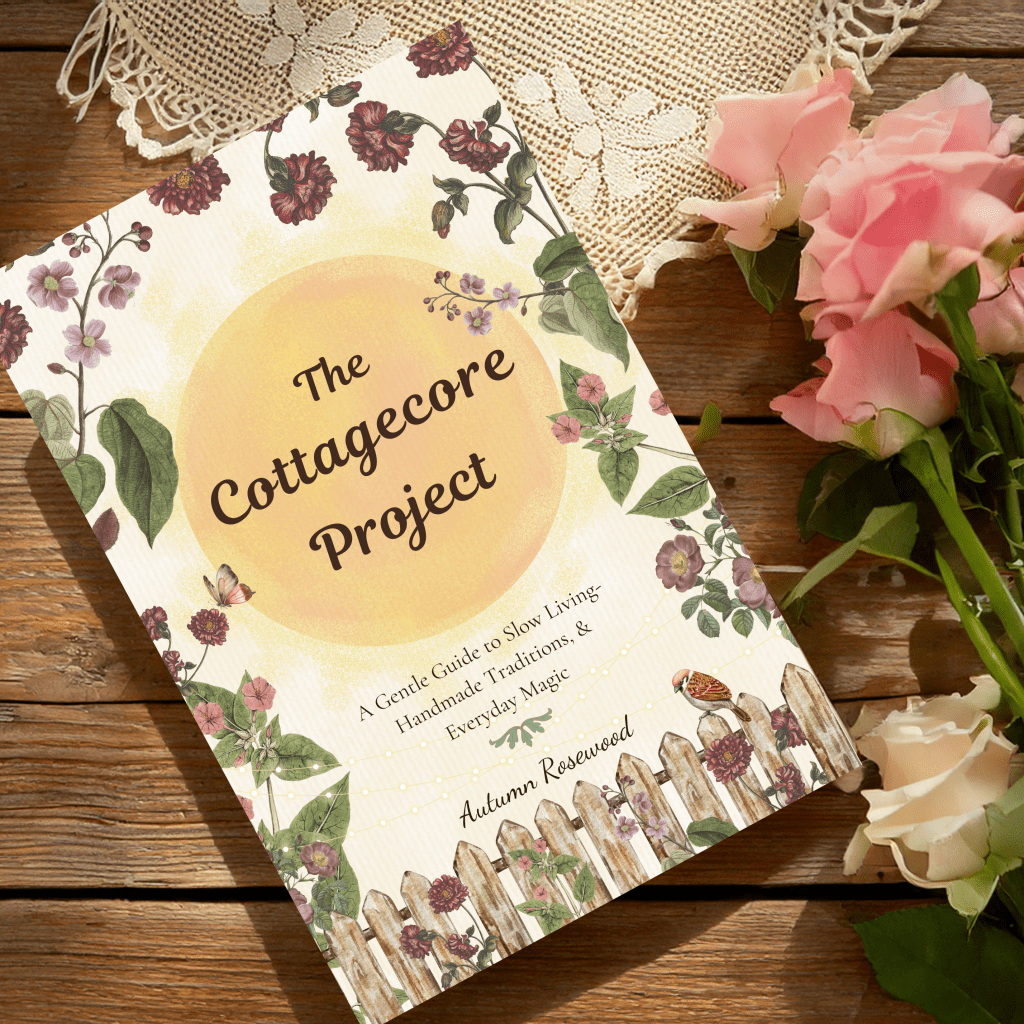

 Autumn Rosewood
Leave a comment